Pages

Wednesday, 7 November 2018

ARTEMIS & EPHESUS (Temple of Artemis)👌✌👍

The Temple of Artemis at Ephesus located on the western coast of Asia Minor (modern Turkey) was built in the 6th century BCE, and such was its tremendous size, double the dimensions of other Greek temples including the Parthenon, that it was soon regarded as one of the Seven Wonders of the ancient world. Destroyed by a deliberate fire in the 4th century BCE and then rebuilt, the great Ionic temple survived until Late Antiquity and the Gothic invasion of c. 267 CE. Once again rebuilt, in 401 CE it was torn down for the last time by a Christian mob. Today only the foundations and a solitary column stand as a reminder of the site where once stood the greatest temple in the ancient Mediterranean.

Ephesus (or Ephesos) was a Greek colony on the eastern coast of Asia Minor founded in the 8th century BCE, although there had been Greek settlers in the area from c. 1200 BCE. The Greek goddess Artemis (Diana to the Romans) was particularly important to the Ephesians, indeed her birthplace was considered by them as nearby Ortygia (for other Greeks it was Delos). Artemis was the goddess of chastity, hunting, wild animals, forests, childbirth, and fertility. The goddess’ cult at Ephesus included eastern elements (borrowed from goddesses such as Isis, Cybele, and the “Mistress of the Animals”), as did her representation in art, with surviving statues, unlike elsewhere in Greece, being covered in eggs as symbols of her role as a fertility goddess. Hence, the goddess worshipped at Ephesus is often referred to as Artemis Ephesia.    

There had already been several versions of the temple over the centuries at Ephesus, and Herodotus describes the Ephesians tying a rope 1243 metres (4081 ft) long between the old temple and the city in a desperate and as it turned out futile hope that their dedication of the entire city to Artemis would save them from the Lydians. The city had an up and down relationship with the neighbouring kingdom of Lydia, resisting many attacks but at the same absorbing some cultural elements. The Lydian king Croesus (r. 560-546 BCE) conquered Ephesus between 560 and 550 BCE, and then funded the construction of new buildings, including a great new temple to Artemis or, as the Greek historian Herodotus put it, he “dedicated many columns” (Histories, 1.92). An interesting archaeological find at the site was a column drum carrying the inscription 'dedicated by Croesus'.

BEGUN C. 550 BCE, THE MARBLE TEMPLE WOULD TAKE 120 YEARS TO COMPLETE, & LIKE ITS PREDECESSORS, IT WAS DEDICATED TO ARTEMIS & SO WAS SOMETIMES REFERRED TO AS THE ARTEMISIUM.

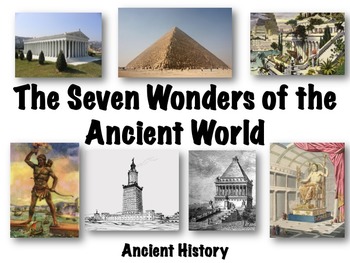





Seven Wonders of the Ancient World

See the famous Seven Wonders of the Ancient World: Walk through the lush Hanging Gardens of Babylon. Climb the great Lighthouse at Alexandria. Stand before the immense statue of Zeus at Olympia. Marvel at the beauty of the Temple of Artemis in Ephesus...


The ancient Greeks loved to compile lists of the marvellous structures in their world. Though we think of the Seven Wonders of the Ancient World as a single list today, there were actually a number of lists compiled by different Greek writers. Antipater of Sidon and Philon of Byzantium drew up two of the most well-known lists.


Why seven? The Greeks thought that the number had mystical significance. Perhaps because it was the total of the known planets (Mercury, Venus, Mars, Jupiter, Saturn) along with the Sun and Moon.


Many of the lists agreed on six of the seven items. The final place on some lists was awarded to the Walls of the City of Babylon. On others, the Palace of Cyrus, king of Persia took the seventh position. Finally, toward the 6th century A.D., the final item became the Lighthouse at Alexandria.


Since then it was Greeks who made the lists it is not unusual that many of the items on them were examples of Greek culture. The writers might have listed the Stonehenge if they'd seen it, but this place was beyond the limits of their world.


It is a surprise to most people to learn that not all the Seven Wonders existed at the same time. Even if you lived in ancient times you would have still needed a time machine to see all seven. While the Great Pyramid of Egypt was built centuries before the rest and is still around today (it is the only "wonder" still intact) most of the others only survived a few hundred years or less. The Colossus of Rhodes stood only a little more than half a century before an earthquake toppled it. 😀😀😀


Tuesday, 11 September 2018


Image result for rice bubble nutrition information

  1. Be easy to read, 
  2. Be in english, 
  3.  True Facts
  4.  Surviving percentage,
  5.   Algergy dec
  6.  Warning Statment, 
  7.  Advisory statement,
  8.  Date
  9.  Expiary
  10.   Made in...

Thursday, 23 August 2018

Digestive System

Mouth
  • This is where we ingest food (eat our food)
  • We do this using our teeth: Canine, Incisors, Molar
  • Canine teeth stab and rip food
  • Incisors cut our food
  • Our molar masticate (grind) the food
  • The Salivary Glands release saliva into our mouth
  • Saliva starts to break down sugars and lubricates the food


  • This is a tube connecting the mouth to the stomach
  • Food is pushed down to the stomach by the action of peristalsis
Stomach
  • The stomach mixes food into a paste. 
  • Some food is torn down in the stomach. 
  • Stomach acid removes bacteria.
Duodenum
  • This is the first part of the Small Intestine
  • More chemicals are joined in from the Pancreas and Gall Bladder
Pancreas

  • This adds a chemical into the duodenum to neutralize the stomach acid
  • The Pancreas also adds more chemicals into the duodenum to break down food. 


Why do we have a mouth?
We have a mouth to ingest our food


What else do we do with our mouth?
We eat and our salivary glands help us break our food down


Tuesday, 7 August 2018

The Family Of Matariki

My research was about the family of Matariki


Matariki was actually named after the Mother star Matariki.

What I find interesting is that there are actually six sisters and
a mother not seven sisters.

I think my best features in this is my resilience even when
I wanted to give up I still completed my work and my research.

I want maybe a different subject maybe like weaving.


I would Like to thank my Social Studies teacher for the
opportunity to learn something like this it is a great opportunity
to learn about Maori Culture.

Wednesday, 27 June 2018

I wonder??

I wonder what animals are in Greece forests?

The Kri-Kri Goat                           
Kri-kri goat, Samaria Gorge, Crete

The Creten Spiny Mouse
An Acomys minous (Cretan spiny mouse), part of the living museum exhibition of the Natural History Museum of Crete

The Beech Marten
A pale beech marten
Beech marten

The Badger
A small badger, or arcalos, from Crete

The Cypriot Mouflon
Photo of a male wild Cyprus mouflon

The Loggerhead Turtle
Loggerhead Turtle


Loggerhead Sea Turtle (Caretta caretta)


The Dolphin
Common Dolphins

The Mediterranean Monk Seal
Mediterranean monk seal relaxing in sea shallows


Critically endangered Mediterranean monk seal, Monachus monachus


Tuesday, 19 June 2018

Wood tech

In Wood tech we made a bunch of stuff it was challenging and hard but was fun to make.
What am I learning: I am learning to use different tools to make various things

How does this show my learning: This shows my learning as I have made; bottle opener, bull roarer and more

What am I wondering: I am wondering if I will use this method later in life

What can I improve on: I can improve on my concentration and focus on my work without getting distracted